Assessing whether the Government’s
Life Sciences Sector Plan can deliver
for UK plc, the NHS and patients

Introduction
This short research pamphlet provides a snapshot assessment of the UK
Government’s plans for life sciences. It follows the publication of the Life Sciences
Sector Plan (Sector Plan) and the Ten Year Health Plan.1 2
The publication of both documents comes at an important and challenging
time for the UK life sciences industry. The mid scheme review of the voluntary
pricing scheme between Government and industry was moved forward following
concerns about the size of the industry rebate and how this compared to those in
other countries.3 Ultimately there was no agreement on the outcome of the mid
scheme review and the industry representative body, the Association of British
Pharmaceutical Industries (ABPI), did not publicly endorse the Sector Plan and Ten
Year Health Plan when they were published.
The Government’s policy plans also come against a backdrop of heightened global
competition on life sciences. President Trump’s Executive Order ‘Delivering most
favoured nation prescribing to American Patients’ aims to reduce the costs of
medicines for US citizens.4 The threat of tariffs being applied to pharmaceuticals
has also seen a number of major pharmaceutical firms commit to expand their
operations in the United States. More widely, competition for life sciences
investment globally is increasing as countries look to the sector for inward
investment opportunities to support economic growth.5
The challenging UK operating environment has also seen a number of high profile
examples where the UK has missed out on inward investment or where new
medicines are not being launched or made available, despite being available in
other countries.6 7
Summary of research findings
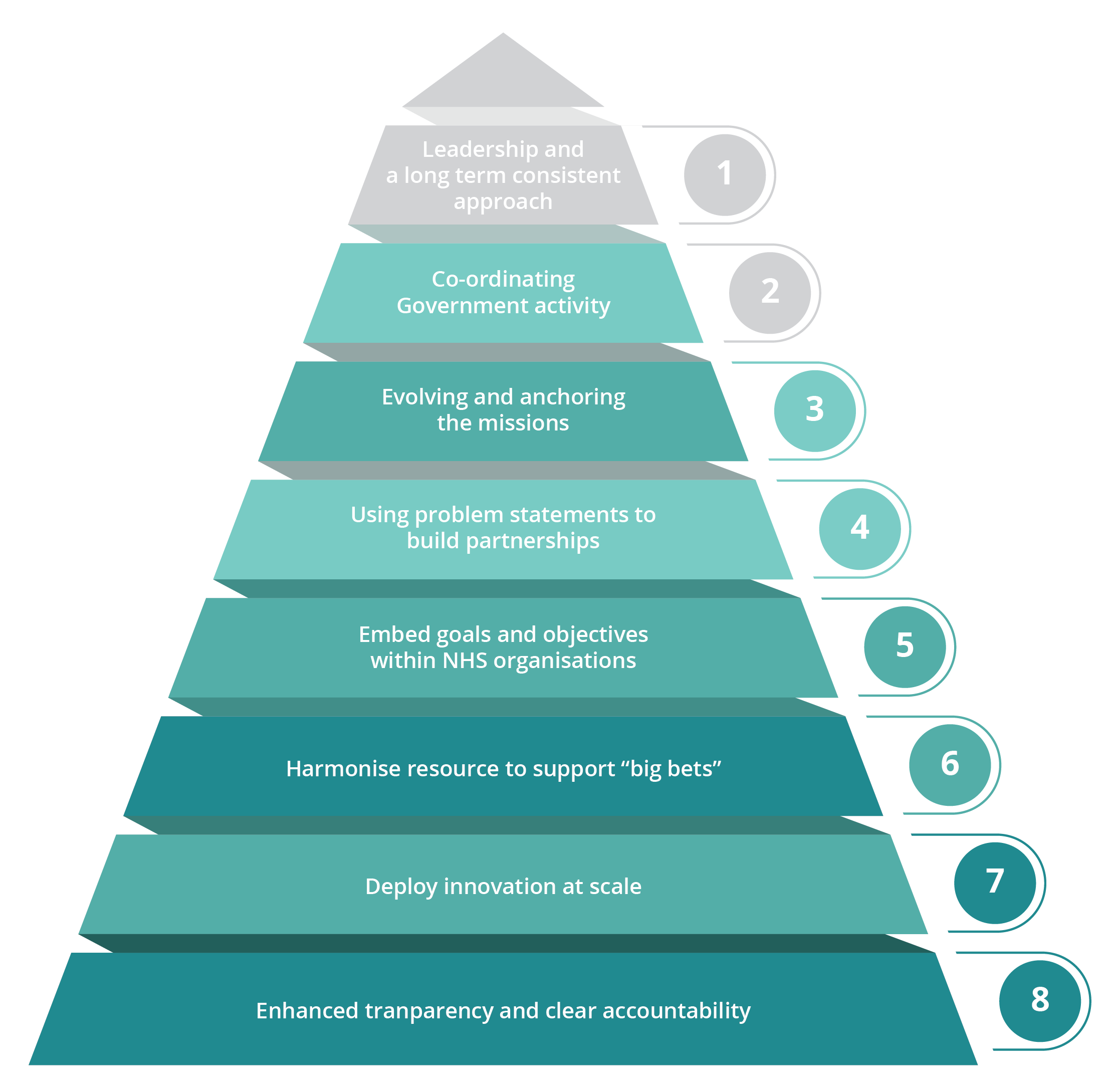
The Sector Plan and Ten Year Plan proposes positive change for life sciences policy in a number of areas. These include:
- A strong Government backed narrative on the importance of the connection between life sciences investment, economic growth and improved population health outcomes
- High levels of ambition grounded in a balanced scorecard of specific metrics
- Commitments to bolster the work of the OLS and join-up Government activity on life sciences through a refreshed Life Sciences Council
- A regional and devolved policy agenda to supporting scaling innovation at scale through Regional Health Innovation Zones
- Greater transparency and accountability for policy delivery through dedicated SROs and clear timelines
- Refreshing the Innovation Scorecard to more closely track and monitor the uptake of innovation in the NHS
In some areas – such as how the future and remodelled Life Sciences Council will operate and how Regional Health Innovation Zones will work alongside Health Innovation Networks – it is clear that more detail is both needed and will be forthcoming.
However and despite it being one of the three Pillars identified – the links between
the Plan and NHS reform remain loosely connected. Whilst the Sector Plan includes
a narrative of the industry’s importance to the NHS and the policy changes
required, specifics are light. There is little on how the Sector Plan will support the
delivery of the Ten Year Health Plan’s three shifts (hospital to community, analogue
to digital, treatment to prevention) – beyond references to clinical trials digitisation.
The Plan adopts an ‘implicit’ rather than ‘explicit’ approach – i.e. in taking actions
to improve the life sciences operating environment (for example through faster
regulation, and better tracking of medicine adoption) healthcare outcomes will
improve and therefore such efforts align to the general mission of the Ten Year
Health Plan.
We would argue that based on the challenges seen in previous policy frameworks
that what is needed this time is more ‘explicit’ in nature – i.e. how the Sector Plan
will more directly support the NHS operational reform agenda. Such an approach
would address questions such as:
- How will new medicines and diagnostics support moving care from hospital to
community and the delivery of neighbourhood health services? - How will the Sector Plan commitments support the disease priorities of the
Ten Year Health Plan’s Modern Service Frameworks and Government goals of
improving health life expectancy? - How do the Government Healthcare Goals programme relate to the Ten Year
Health Plan and Modern Service Frameworks?
It would also be grounded in measures within the NHS Operational Guidance and
Oversight Frameworks published annually. There was only a short section on life
sciences in the Medium Term Planning Framework published in October 2025
focused on clinical trials and genomics and no performance metrics within the NHS
Oversight Framework.53
Therefore whilst the Sector Plan delivers welcome progress in a number of areas,
the thorny issue of its connectivity with NHS reform remains under-developed.
Without a more explicit approach to this, the Plan’s rhetoric of connecting
economic and healthcare goals may continue to be disjointed. The delivery plan
for the Ten Year Health Plan – including how industry can support the MSFs – and
the next round of NHS planning guidance are opportunities to address this. In
taking such action there will be opportunities for Government and industry to
build a constructive future partnership, which is vital given the current challenging
backdrop both internationally and domestically.
1https://assets.publishing.service.gov.uk/media/688c90a8e8ba9507fc1b090c/Life_Sciences_Sector_Plan.pdf
2 https://assets.publishing.service.gov.uk/media/6888a0b1a11f859994409147/fit-for-the-future-10-year-healthplan-for-england.pdf
3 https://www.abpi.org.uk/media/news/2025/august/accelerated-review-of-vpag-concludes-without-agreement/
4 https://www.whitehouse.gov/presidential-actions/2025/05/delivering-most-favored-nation-prescriptiondrugpricing-to-american-patients/
5 https://www.futurehealth-research.com/delivering-the-life-science-vision-new-future-health-report/
6 https://committees.parliament.uk/oralevidence/15562/html/
7 https://www.thetimes.com/uk/healthcare/article/breast-cancer-drug-trodelvy-held-nhs-bw6m2zb7m
This report is sponsored by Novartis Pharmaceuticals Ltd and has been authored by Future Health. The views and conclusions of the report remain those of Future Health and should be attributed as such. Future Health takes full responsibility for the content of the report and associated publications.